
How to Hide Gridview and Show the selected gridview row details in Form View using ASP.NET C#


In this post I'm going to post details about how to hide full Gridview by selecting individual gridview row and show that gridview row details in Formview;

In this example, I'm using AdventureWorks Database and datebase table name HumanResources.Employee

Click here to Download AdventureWorks Database 

Here I'll post the code and snapshot details 

1. Design View


Add connection string code in web.config as below :


2.Design View's Source code in Default.aspx


3. Code Behind : Default.aspx.cs


4. Output: a) Gridview Shown


4 b) After clicking Full detail in First row in Gridview; Gridview has been hidden and showing Form view of the particular grid view rows full details
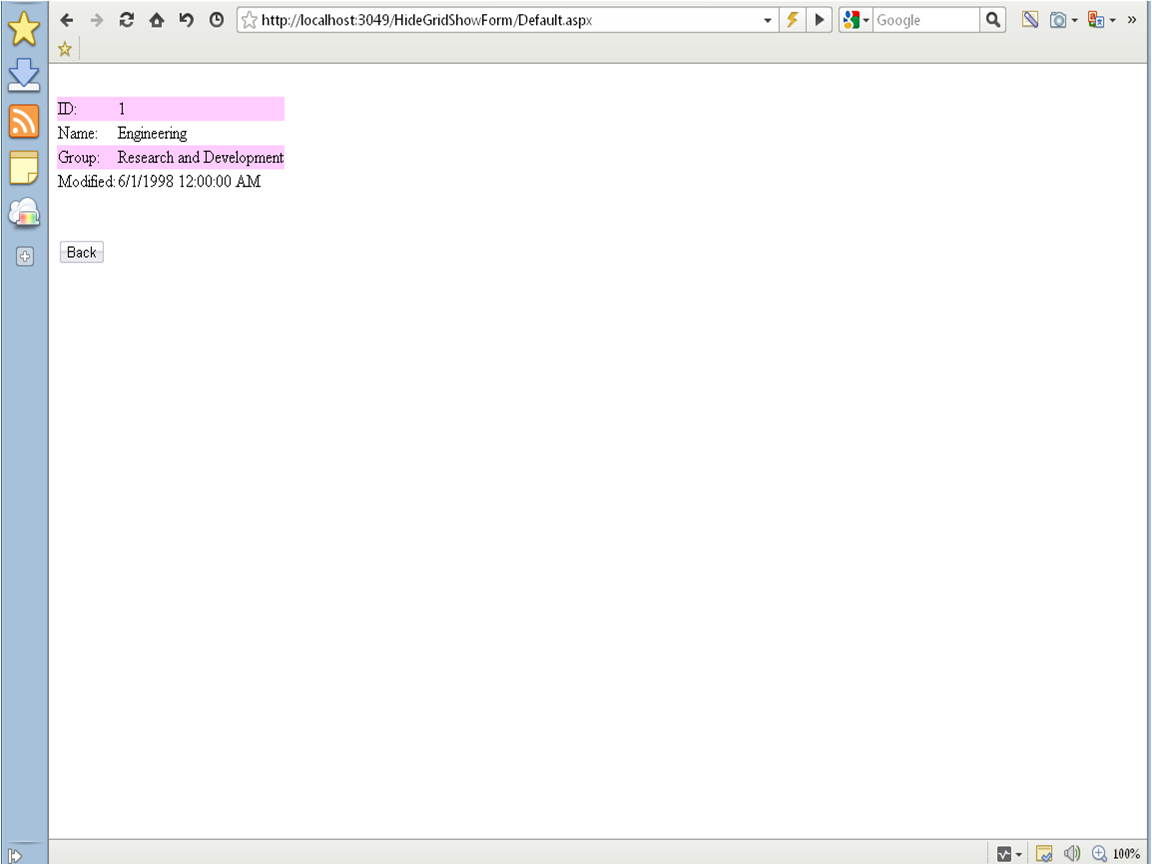

4.c) Click Back Button then Grid view has been shown and Form view has been hidden

Comments

Popular posts from this blog

Java Swing MySql JDBC: insert data into database

Program import javax.swing.*; import java.awt.*; import java.awt.event.*; import java.sql.*; public class insertswing implements ActionListener {   JFrame fr;JPanel po;   JLabel l1,l2,main;   JTextField tf1,tf2;   GridBagConstraints gbc;   GridBagLayout go;   JButton ok,exit; public insertswing(){ fr=new JFrame("New User Data "); Font f=new Font("Verdana",Font.BOLD,24); po=new JPanel(); fr.getContentPane().add(po); fr.setVisible(true); fr.setSize(1024,768); fr.setDefaultCloseOperation(JFrame.EXIT_ON_CLOSE); po.setBackground(Color.WHITE); go=new GridBagLayout(); gbc=new GridBagConstraints(); po.setLayout(go); main=new JLabel("Enter User Details "); main.setFont(f); l1=new JLabel("Name  :");tf1=new JTextField(20); l2=new JLabel("User Name  :");tf2=new JTextField(20); ok=new JButton("Accept"); exit=new JButton("Exit"); gbc.anchor=GridBagConstraints.NORTH;gbc.gridx=5;gbc.gridy=0; go.s...

Guidewire Policy - Spin Up Spin Off Transactions

Guidewire PolicyCenter - Spin Up and Spin Off Policy Job Transactions In Guidewire PolicyCenter, "spin up" and "spin off" refer to specific actions you can take with policy job transactions. These terms are related to how new policy transactions (such as renewals, endorsements, or cancellations) are created or modified. Here's an explanation of each: 1. Spin Up: "Spin up" refers to the process of creating a new policy job from an existing policy or transaction. When you "spin up" a policy job, you're essentially initiating a new transaction based on an existing policy. This new transaction could be a renewal, an endorsement, or any other type of policy change. For example: - Renewal : When a policy's term is about to expire, you might "spin up" a renewal job to create a new policy term based on the existing one. The new job will carry forward much of the existing policy's data but may allow for updates or cha...

Guidewire Reinstatement and Rewrite

Guidewire Reinstatement, Rewrite Mid Term, Rewrite Full Term, and Rewrite New Term In Guidewire PolicyCenter, different types of policy transactions allow users to modify, renew, reinstate, or rewrite policies under various circumstances. Here̢۪s an explanation of Reinstatement, Rewrite Mid Term, Rewrite Full Term, and Rewrite New Term, along with their similarities, differences, and example scenarios. 1. Reinstatement Definition: - Reinstatement is a process that brings a canceled policy back into force. This is typically done after a policy has been canceled due to non-payment or other reasons, and the insurer agrees to reinstate the policy, often after the insured has met certain conditions (e.g., paying outstanding premiums). Scenario Example: - A policyholder misses their premium payment, and the policy is canceled. After paying the overdue amount, the insurer reinstates the policy without any changes to the original policy terms and conditions. Key Points: - The poli...